PRINCIPLE OF EQUALISING BACKSIGHT AND FORESIGHT
DISTANCES
In levelling, the line of collimation should
be horizontal when the staff readings are taken. Again the fundamental relation
is that the line of collimation should be exactly parallel to the axis of the
bubble. So, when the bubble is at the centre of its run, the line of
collimation is just horizontal. But sometimes the permanent adjustment of level
may be disturbed and the line of collimation may not be parallel to the axis of
the bubble. In such case, due to the inclination of the line of collimation,
cross in levelling are lickly to occur. But it is found that if the backsight
and foresight distances are kept equal, then the error due to the inclination
of the collimation line is automatically eliminated.
Case I – When
the line of collimation inclined upwards Let A and
B be two points whose true difference of level is required. The level is set up
at O, exactly midway between A and B (Fig.
– L.16).
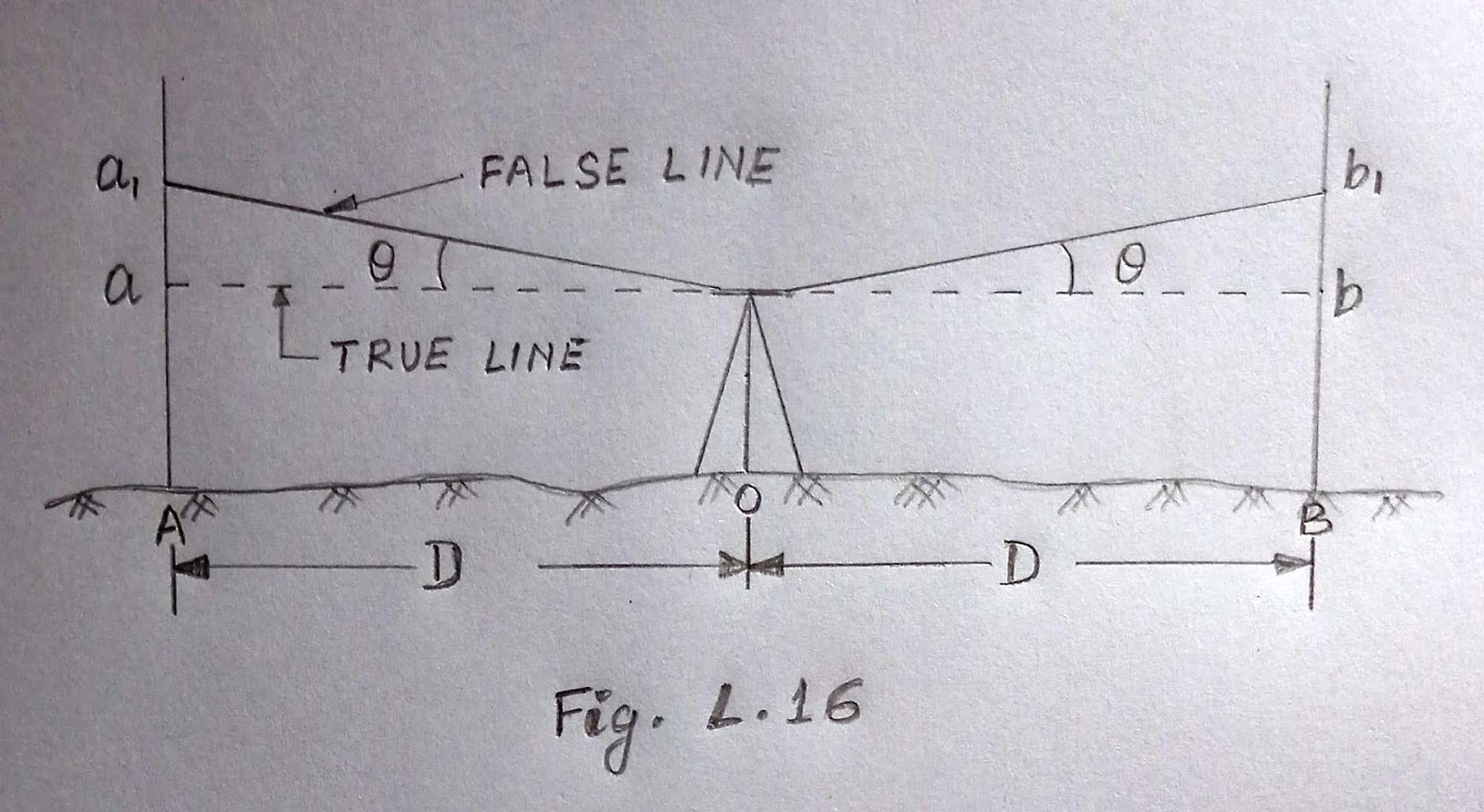
Let θ =
angle of inclination of collimation line.
Aa = true reading
Aa₁ = observed staff reading on A
Error =
Aa₁ - Aa = aa₁ = D tanθ
So true
reading Aa = Aa₁ - aa₁ = Aa₁ - D tanθ
………..(1)
Similarly,
Bb = true reading
Bb₁ =
observed staff reading on B
Error =
Bb₁ - Bb = bb₁ = D tanθ
So true
reading Bb = Bb₁ - bb₁ = Bb₁ - D tanθ
………….(2)
From
(1) and (2),
True
difference of level between A and B = Aa – Bb
= Aa₁ - D tanθ - Bb₁ + D tanθ
= Aa₁ - Bb₁
Thus,
this is seen that the error due to inclination of the collimation line is
completely eliminated and the apparent difference is equal to the true
difference.
Case II – When
the line of collimation inclined downwards The staff readings on A and B are taken after setting the level at O.
Suppose the readings are a₂ and b₂ (Fig.
– L.17).

Here, Aa = true staff reading
Aa₂ = observed staff reading on A
Error =
Aa - Aa₂ = aa₂ = D tanθ
So true
reading Aa = Aa₂ + aa₂ = Aa₂ + D tanθ
………..(1)
Similarly,
Bb = true reading
Bb₂ =
observed staff reading on B
Error =
Bb - Bb₂ = bb₂ = D tanθ
So true
reading Bb = Bb₂ + bb₂ = Bb₂ + D tanθ
………….(2)
From
(1) and (2),
True
difference of level between A and B = Aa – Bb
=
Aa₂ + D tanθ - Bb₂ - D tanθ
=
Aa₂ - Bb₂
Thus,
this is seen that the error due to inclination of the collimation line is
completely eliminated and the apparent difference is equal to the true
difference.
So, always remember that the level should be
placed exactly midway between backsight and foresight in order to eliminate any
error.
CORRECTION TO BE APPLIED
(1). Curvature
correction: For long sights, the curvature of the earth effect staff
readings. The line of sight is horizontal, but the level line is curved and
parallel to the mean spheroidal surface of the earth (Fig. – L.18).
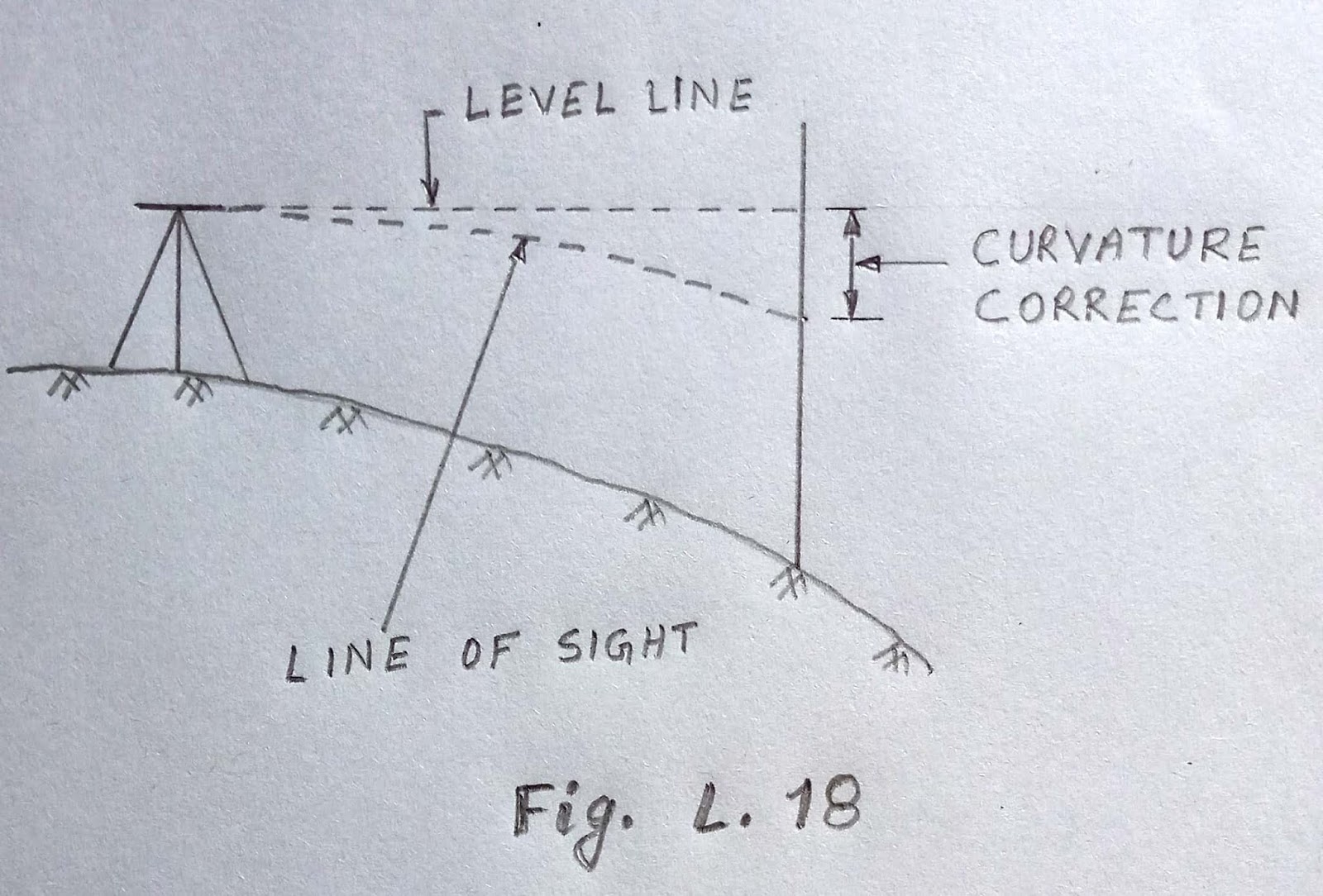
The vertical distance between the line of
sight and level line at a particular place is called the curvature correction.
Due to curvature, objects appear lower than they really are.
Curvature correction always subtractive (i.e.
negative)
Let AB = D = horizontal distance in kilometers.
BD = Cc = curvature correction
DC = AC = R = radius of earth
DD’ = diameter, considered as 12742 km
From
right angle triangle ABC (Fig. – L.19).

BC² = AC² +
AB²
(R + Cc) ² = R² + D²
or R² + 2RCc + Cc² = R² + D²
or 2R X Cc = D² (Cc² is neglected as it is very small
in comparison to the
diameter
of the earth)
Curvature
correction Cc = D²/2R
Cc = (D² x 1000)/12742 = 0.0785D² m (negative)
Hence, True staff reading = observed staff reading
– curvature correction.
(2). Refraction
correction: Rays of light are refracted when they pass through layers
of air of varying density. So, when long sights are taken, the line of sight
refracted towards the surface of the earth in a curved path. The radius of this
curve seven times that of the earth under normal atmospheric conditions. Due to
the effect of refraction, objects appear higher than they really are. But the
effect of curvature varies with the atmospheric conditions.
However,
on an average, the refraction correction is taken one-seventh of the curvature
correction.
Cr = 1/7 x D²/2R
Refraction
correction, Cr = 1/7 x 0.0785D² = 0.0112D² m (positive)
Refraction correction is always
additive (i.e. positive)
True
reading = observed staff reading + refraction correction
(3). Combined
correction: The combined effect of curvature and refraction is as
follows:
Combined
correction = curvature correction + refraction correction
= -0.0785D² + 0.0112D²
= -0.0673D² m
So,
combined correction always subtractive (i.e. negative)
True
reading = observed staff reading - combined correction
Combined
correction may also be expressed as
D²/2R – 1/7 x D²/2R = 6/7 x D²/2R (negative)
(4). Visible
horizon distance
Let AB = D = visible horizon distance in
kilometers (Fig. – L.20).

Considering
curvature and refraction corrections,
h = 0.0673D²
D = √(h/0.0673)
(5). Dip
of horizon
AB = D
= tangent of earth at A
BD =
horizontal line perpendicular to OB
θ = dip
of horizon
The
angle between the horizontal line and the tangent line is known as the dip of
the horizon. It is equal to the subtended by the arc AC at the centre of the
earth (Fig. – L.21).

Dip θ = arc AC/radius of earth in radians
θ =
D/R, in radians (Taking AC approx, equal to AB)
Hear, D
and R must be expressed in the same unit.
(6). Sensitiveness
of the bubble: The term sensitiveness in the context of a bubble means
the effect caused by the deviation of the bubble per division of the graduation
of the bubble tube.
Sensitiveness is expressed in term of the
radius of the curvature of the upper surface of the tube or by an angle through
which the axis is tilted for the deflection of one division of the graduation.
Determining
sensitiveness: consider Fig.
L.22. Suppose the level was set up at O at a distance D from the staff at
P. The staff reading is taken with the bubble at extreme right end (i.e. at E).
Say it is PA. Another staff reading taken with the bubble at the extreme left
end (i.e. at E₁). Let it is be PB

Let, D = distance between level and staff
S = intercept between the upper and
lower sights,
n = number of divisions through the
bubble is reflected,
R = radius of curvature of the tube,
θ = angle subtended by arc EE₁, and
d = length of the division of the
graduation, expressed in the same unit
as D and S.
Movement
of centre of bubble = EE₁ = nd
Triangle
OEE₁ and ACB are similar.
Here, Rθ = arc EE₁
or θ = EE₁/R = nd/R …….(1)
(as arc EE₁ = chord EE₁)
Again EE₁/R = S/D (height of triangle OEE₁ may be considered
as R)
or nd/R = S/D ……………. (2)
From
(1) and (2),
θ = nd/R = S/D …………(3)
Therefore, R = (nd x D)/S
Let θ’ = angular value for one
division in radians
θ’ = θ/n = S/D x 1/n
radians
θ’ = S/(D x n) x 206265
secs. (1 radian = 206265 secs.)
(Next post
on “RECIPROCAL LEVELLING”)